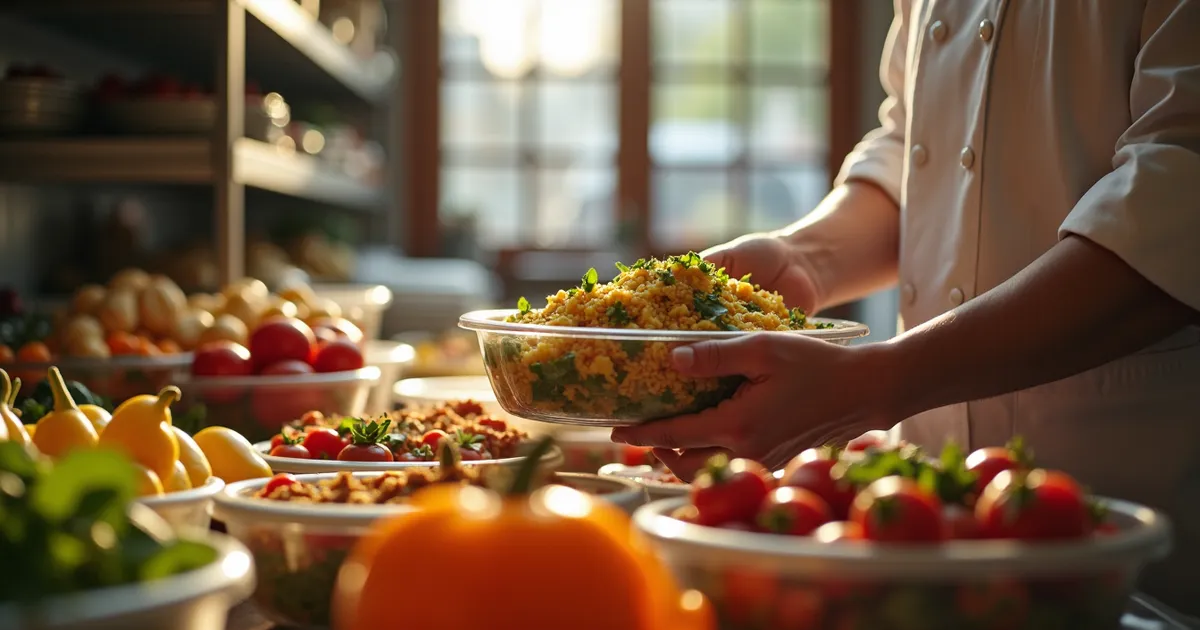
Yes, it affects every bar or restaurant, but not in the same way. Under the text of the law, all hospitality venues must offer customers the chance to take away what they have not eaten, at no additional cost, and say so in the venue. By contrast, the food waste prevention plan and donation agreements are only mandatory if your business is not a microenterprise and exceeds certain sizes.
This guide helps you work out which of the two cases you are in. It is based on the text of the Ley 1/2025 as published in the BOE (Spain's official gazette).
What obligations a bar has under the law
The Ley 1/2025, of 1 April, on the prevention of food loss and waste, was published in the BOE on 2 April 2025. For a restaurant, what matters is in two articles:
| Obligation | Who has it | Article |
|---|---|---|
| Make it easy for customers to take away, at no additional cost, the food they have not consumed (except all-you-can-eat buffets or similar) | All hospitality | Art. 8 |
| Inform about that possibility clearly and visibly in the venue, preferably on the menu | All hospitality | Art. 8 |
| Use containers suitable for food use, reusable or easy to recycle | All hospitality | Art. 8 |
| Apply the hierarchy of priorities against waste and the measures of the Ley 7/2022 on food waste | Businesses that are not microenterprises | Art. 6.1 and 6.2 |
| No contract may expressly prevent food donation (the clause would be void) | Businesses that are not microenterprises | Art. 6.3 |
| Have a plan for preventing food loss and waste | Businesses that are not microenterprises and not exempted by floor area | Art. 6.4.a |
| Promote agreements to donate surplus to social organisations or food banks, unless it is unfeasible and that is justified | Businesses that are not microenterprises and not exempted by floor area | Art. 6.4.b |
| Avoid actions aimed at leaving food in a condition unfit for consumption | Businesses that are not microenterprises | Art. 6.5 |
The key exception for a small bar: art. 6.6 says microenterprises are excluded from the obligations in the previous paragraphs of that article (art. 6), and art. 6.4.c exempts hospitality and catering in establishments of up to 1,300 m² from the obligations in paragraph 4 (the plan and the donation agreements). So an ordinary restaurant does not need a written prevention plan.
That said, art. 8 (taking food away at no additional cost) is a different article, and according to its text it has no exemption by size: the exclusion of microenterprises refers only to art. 6. If you have doubts about your case, check with your adviser or with the department of your autonomous community.
What counts as a microenterprise for the law
Art. 3.f defines microenterprises as those that employ fewer than ten people and have an annual turnover or annual balance sheet not exceeding €2 million. A family bar with few employees usually qualifies, but check with your own numbers.
Be careful if you have several venues: art. 6.4.c says that, regardless of floor area, those that operate under the same tax ID (CIF) and add up to more than 1,300 m² are bound. This only affects those who are not microenterprises (art. 6.6).
The container for taking food away
Art. 8 asks that the customer be able to take away what they have not consumed:
- At no additional cost. You cannot charge for the fact of taking the food away. The law makes an exception for single-use plastic containers, for which it refers to title V of the Ley 7/2022 (which includes charging for them) and to art. 18 of Real Decreto 1021/2022.
- Food-safe containers, reusable or easy to recycle. Single-use plastic ones have their own rules.
- A visible notice in the venue, better on the menu.
- All-you-can-eat buffet: exempted because the food is not limited.
It is not entirely new: art. 18.5 of Real Decreto 1021/2022 already set out the obligation to provide containers at no additional cost and to accept customers bringing their own container.
When each thing is required
The twentieth final provision of the Ley 1/2025 sets the calendar:
| What | Date | Where it appears |
|---|---|---|
| Publication in the BOE | 2 April 2025 (BOE no. 80) | Header of the law |
| General entry into force | According to the text in the BOE, the law comes into force on 2 January 2025 | Twentieth final provision |
| Mandatory measures of art. 6 | They apply once one year has passed since publication in the BOE (2 April 2025), that is, from April 2026 | Twentieth final provision |
Put plainly: if you are one of those bound by art. 6, that year has already passed. If you are not, what affects you most is art. 8, and the take-away container is what you must have sorted out.
What fines the law sets
The Ley 1/2025 classifies infringements as minor, serious and very serious, and sets these bands in its art. 21:
| Classification | Band in the law (art. 21) | Examples cited by the law (art. 20.2) |
|---|---|---|
| Minor | Warning or fine of up to €2,000 | Not donating when bound to, when the means exist and it is feasible (art. 20.2.a.2.º); preventing donation by contract (art. 20.2.a.4.º) |
| Serious | From €2,001 to €60,000 | Not having the plan when bound to (art. 20.2.b.1.º); intentionally destroying food that is fit for consumption (art. 20.2.b.2.º bis) |
| Very serious | From €60,001 to €500,000 | Repeating serious infringements within two years (art. 20.2.c) |
These are the limits of the law, not the fine a specific bar would get. Three points to bear in mind:
- The autonomous communities may increase these thresholds (art. 21) and handle penalties in their territory (art. 20.2), so the real amount and the procedure depend on where your venue is.
- Only for minor infringements can a period be given to correct the failure (art. 22).
- Art. 20 does not expressly name the infringement of not offering to let customers take food away. The autonomous communities, where they regulate their penalty regime, cover the infringements in art. 20.2, so how failure to comply with art. 8 is classified and penalised depends on each community. Ask in yours.
Practical steps for a bar or restaurant
- Check your size: number of people, annual turnover or balance sheet and square metres, adding up venues with the same tax ID (CIF).
- Put the notice on the menu, with a simple sentence.
- Choose the container: food-safe, reusable or recyclable, and check the rules on single-use plastic.
- Decide what to do with surplus food, even if you are not bound: what gets used, what gets frozen and what can be donated.
- If you are bound, write the plan: what waste you generate, what measures you apply and which organisation you donate to. Art. 7 sets the minimum content of donation agreements (collection, transport and storage, commitments of the parties, selection of food by the donor and the possibility of rejection by the organisation).
For step 5 you do not need to start from scratch: here you see what applies to your venue, build the plan with the measures you already use and get the month's sheet to log your waste.
What matters, whichever method you use, is that the plan reflects what you really do in your kitchen.
This guide is for information only and is not legal advice.
 Verifactu in bars and restaurants: when it becomes mandatory and what to do
 Verifactu and TicketBAI: how they differ and which one applies to your bar or restaurant
 Do you have to list the 14 allergens on the menu of a bar or restaurant in Spain?