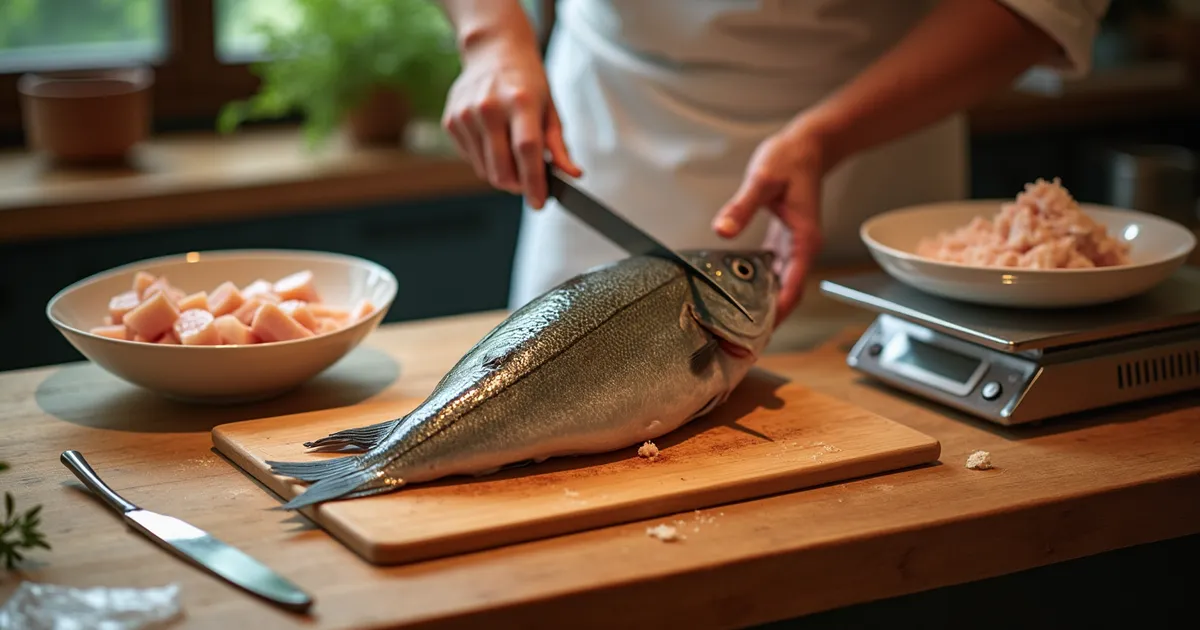
Waste (merma) is the part of a product that you pay for but that does not reach the plate: the potato skin, the bone in the meat, the fish bones or the water lost in cooking. If you do not count it in the costing sheet (escandallo), your dishes cost you more than you think and the price you have set leaves you less margin than you have in your head.
Waste, yield, gross and net
These four words get mixed up a lot, so it is worth making them clear:
- Gross quantity: what you buy and pay for, as it arrives from the supplier.
- Net quantity: what is left after peeling, cleaning or cooking, the amount that really goes on the plate.
- Waste (merma): the percentage lost between gross and net.
- Yield: the percentage you use. Yield = 100% − waste.
If you buy 1 kg of potatoes and, after peeling them, 800 g are left, the waste is 20% and the yield is 80%.
The sum: from net to gross
To find out how much you need to buy for 800 g to reach the plate, you divide by the yield:
Gross quantity = net quantity ÷ (1 − waste)
With the potatoes: 0.8 kg ÷ (1 − 0.20) = 1.00 kg. And at €1.40 a kilo, those potatoes cost you €1.40, not the €1.12 you would get by multiplying the 0.8 kg net by the price.
Example: the tortilla with and without waste
In the article on how to make a costing sheet (escandallo) we calculated a tortilla for 4 portions. With the potatoes counted at 0.8 kg the total was €4.40 and the portion came to €1.10. Now we count those 0.8 kg as net:
- Potatoes: 1.00 kg gross × €1.40 = €1.40 (before €1.12)
- The rest of the ingredients add up to €3.28, as before.
- Total cost: €4.68, that is, €1.17 per portion instead of €1.10.
With a food cost of 30%, the price before VAT goes from €3.67 to €1.17 ÷ 0.30 = €3.90, and with the 10% VAT that applies in hospitality (article 91 of the Ley 37/1992) the menu price is €3.90 × 1.10 = €4.29. That is seven cents more cost per portion, which does not seem like much until you multiply it by the portions you sell in a month.
Another example: the real price of a kilo
There is a useful way to look at it: how much a usable kilo costs you. If you buy a loin at €12 a kilo and lose 25% when you trim it, you only use 75%:
Price per usable kilo = €12 ÷ (1 − 0.25) = €16.00 a kilo
That is the price you have to count on every time you put that loin in a dish.
Careful: the quantity you type is not the same in the template and in the calculator
This is what confuses people most, so read it slowly. Both tools do the sums correctly, but they ask you for the quantity in different ways:
- In the Excel template you type the net quantity (the amount that goes on the plate) and the waste percentage, and the template works out the gross quantity by itself with the formula above. The cost comes from the gross quantity.
- In the costing-sheet calculator on this page you type the gross quantity (the amount you buy, before cleaning or peeling). The cost comes from that quantity, and the waste you enter on the line is for information only: it is noted down, but it does not change the calculation.
If you use the calculator, do the net-to-gross sum yourself before typing. If you use the template, always type what reaches the plate. Mixing the two ways is the easiest way to count the waste twice or not count it at all.
How to measure the real waste of your products
- Weigh the product as it arrives.
- Clean it, peel it or cook it the way you always do.
- Weigh what is left.
- Waste (%) = (initial weight − final weight) ÷ initial weight × 100.
Repeat with several batches, because the same product changes from one purchase to the next. And measure it again if you change supplier, size grade or cooking method.
What to do about high waste
- Check who cleans the product and how. The same piece can lose 15% or 30% depending on how it is handled.
- Make use of what is left over. With trimmings you can make stocks, fonds, fillings or specials.
- Buy the product more prepared if it works out cheaper: sometimes cleaned fish, even if it costs more per kilo, turns out cheaper per portion.
- Change the dish or the price if the real cost no longer matches what you charge.
 Food cost: what it is, how to calculate it and what percentage is reasonable in a bar or restaurant
 How to price a dish and a set lunch menu (menú del día) in your restaurant
 Verifactu in bars and restaurants: when it becomes mandatory and what to do