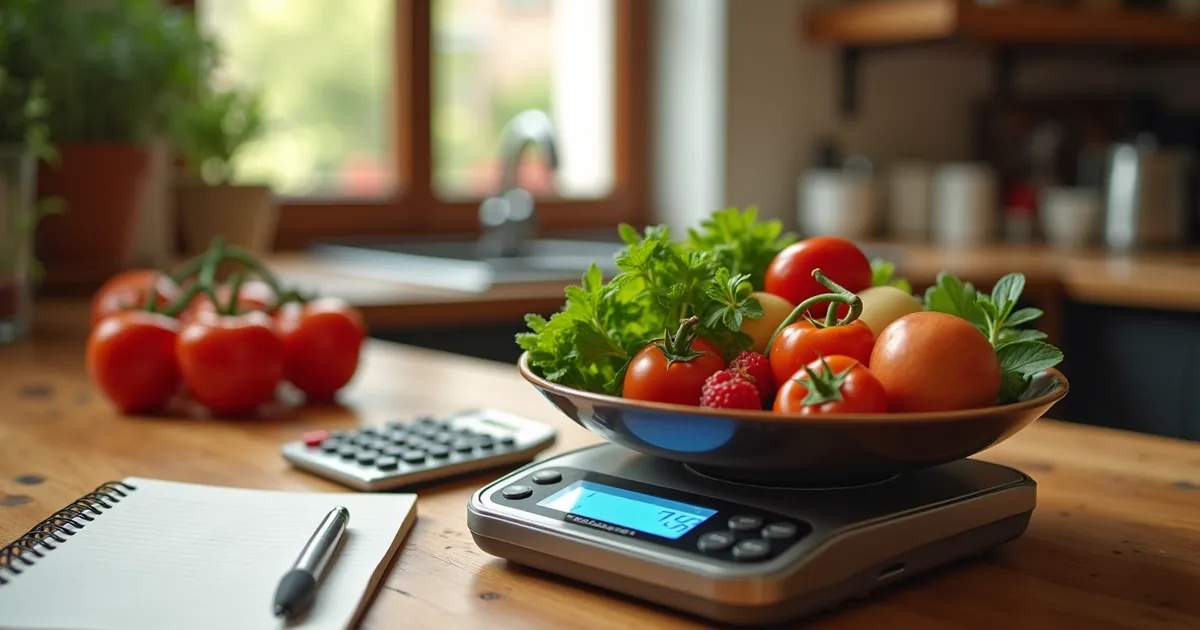
A costing sheet (escandallo) is the record card of a dish where you write down what goes in it, how much of each thing and what each one costs, so you know what each portion costs you and what price it makes sense to sell it at. Without that sum, the menu price tends to be set by eye, and by eye it is easy to sell dishes that leave little or nothing.
This guide takes you through it step by step, with a worked example, and at the end explains how to use the Excel template, which comes with the sums already in place so you only have to change your own figures.
What you need before you start
To cost a dish, all you need to have to hand is:
- The recipe, with the quantity of each ingredient for a specific number of portions.
- The price you pay for each ingredient, looking at your latest invoices or delivery notes.
- The number of portions that recipe makes.
Step 1: list all the ingredients with their quantity
Write down everything that goes into the dish, including what seems unimportant, such as oil, salt or the bread that comes with it. Small things add up. Always use the same unit for each product: kilos, litres or units.
Step 2: put the price of each ingredient
Write down how much a kilo, a litre or a unit costs you according to your latest invoice. If you buy the product in boxes or packs, divide the amount by what the pack contains to get the price per unit.
Step 3: work out the cost of each line
Multiply the quantity by the price. For a potato omelette (tortilla de patatas) for 4 portions it would look like this:
- Potatoes: 0.8 kg × €1.40 a kilo = €1.12
- Eggs: 8 units × €0.28 = €2.24
- Onion: 0.2 kg × €1.20 a kilo = €0.24
- Oil: 0.2 litres × €4.00 a litre = €0.80
Step 4: add up and divide by the portions
The sum of the four lines gives a total cost of €4.40. If that omelette makes 4 portions, each one costs you €4.40 ÷ 4 = €1.10.
Step 5: decide what percentage of the price you want to go on ingredients
That percentage is the food cost: the part of the selling price, before VAT, that is spent on ingredients. In this example we choose 30%, but each venue has its own figure depending on the type of business; in the article on food cost you will see how to choose it.
The sum for the price before VAT is: portion cost ÷ food cost. That is, €1.10 ÷ 0.30 = €3.67 (rounded to the cent).
Step 6: add VAT to get the menu price
The price the customer sees includes VAT. Food served in hospitality is taxed at 10% under article 91 of the Ley 37/1992, so €3.67 × 1.10 = €4.04 per portion.
If you want to check what margin you are left with at that price: €3.67 minus €1.10 of cost is €2.57 per portion, which is roughly 70% of the price before VAT.
Step 7: review it when prices change
A costing sheet is not a snapshot. If oil or eggs go up, the portion costs more and the same menu price leaves you less. Look at your costing sheets every time an invoice arrives with a big change.
How to use the Excel template
The Excel template comes with the formulas in place and an example already filled in (a carbonara pasta with five ingredients) so you can see how it works. To use it:
- Change the name of the dish and the number of portions.
- Replace the example ingredients with your own, with their quantity and price.
- Set the VAT and the food cost you are aiming for.
- Read the result: total cost, cost per portion, recommended price before and after VAT, and the food cost you would have at the price you charge today.
One thing to bear in mind about waste (mermas), meaning what you lose when you peel, clean or cook a product: in the Excel template you type the net quantity, the amount that ends up on the plate, and the template works out the quantity you have to buy. We explain it with an example in the article on waste and yield.
If you prefer to do it without Excel
You can also work out the costing sheet of a dish right here, without downloading anything: you enter the ingredients and it gives you back the cost of the portion. In that calculator the quantity you type is the one you buy, before peeling or cleaning.
Common mistakes
- Forgetting the small ingredients. Oil, salt, spices and the bread on the table cost money too.
- Calculating with the price on an old invoice. Prices move; use the ones from your latest purchases.
- Mixing prices with and without VAT. Calculate costs and margin before VAT, and add VAT only at the end.
- Not counting waste. If you peel, clean or cook a product, you buy more than reaches the plate.
- Doing it once and forgetting it. Review the dishes you sell the most fairly often.
 Verifactu in bars and restaurants: when it becomes mandatory and what to do
 Verifactu and TicketBAI: how they differ and which one applies to your bar or restaurant
 Do you have to list the 14 allergens on the menu of a bar or restaurant in Spain?